


Page 95 - Demo
P. 95
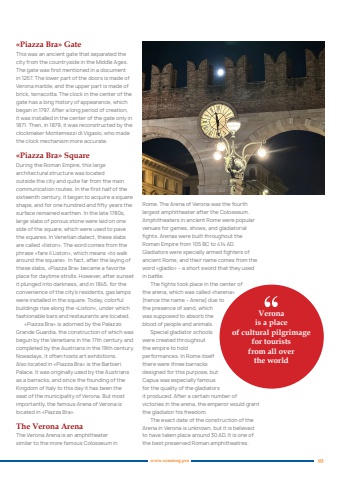
%u00abPiazza Bra%u00bb GateThis was an ancient gate that separated the city from the countryside in the Middle Ages. The gate was first mentioned in a document in 1257. The lower part of the doors is made of Verona marble, and the upper part is made of brick, terracotta. The clock in the center of the gate has a long history of appearance, which began in 1797. After a long period of creation, it was installed in the center of the gate only in 1871. Then, in 1879, it was reconstructed by the clockmaker Montemezzi di Vigasio, who made the clock mechanism more accurate.%u00abPiazza Bra%u00bb SquareDuring the Roman Empire, this large architectural structure was located outside the city and quite far from the main communication routes. In the first half of the sixteenth century, it began to acquire a square shape, and for one hundred and fifty years the surface remained earthen. In the late 1780s, large slabs of porous stone were laid on one side of the square, which were used to pave the squares. In Venetian dialect, these slabs are called %u00abliston%u00bb. The word comes from the phrase %u00abfare il Liston%u00bb, which means %u00abto walk around the square%u00bb. In fact, after the laying of these slabs, %u00abPiazza Bra%u00bb became a favorite place for daytime strolls. However, after sunset it plunged into darkness, and in 1845, for the convenience of the city%u2019s residents, gas lamps were installed in the square. Today, colorful buildings rise along the %u00abListon%u00bb, under which fashionable bars and restaurants are located.%u00abPiazza Bra%u00bb is adorned by the Palazzo Grande Guardia, the construction of which was begun by the Venetians in the 17th century and completed by the Austrians in the 19th century. Nowadays, it often hosts art exhibitions. Also located in %u00abPiazza Bra%u00bb is the Barbieri Palace. It was originally used by the Austrians as a barracks, and since the founding of the Kingdom of Italy to this day it has been the seat of the municipality of Verona. But most importantly, the famous Arena of Verona is located in %u00abPiazza Bra%u00bb.The Verona ArenaThe Verona Arena is an amphitheater similar to the more famous Colosseum in Rome. The Arena of Verona was the fourth largest amphitheater after the Colosseum. Amphitheaters in ancient Rome were popular venues for games, shows, and gladiatorial fights. Arenas were built throughout the Roman Empire from 105 BC to 414 AD. Gladiators were specially armed fighters of ancient Rome, and their name comes from the word %u00abgladio%u00bb %u2013 a short sword that they used in battle.The fights took place in the center of the arena, which was called %u00abharena%u00bb (hence the name %u2013 Arena) due to the presence of sand, which was supposed to absorb the blood of people and animals.Special gladiator schools were created throughout the empire to hold performances. In Rome itself there were three barracks designed for this purpose, but Capua was especially famous for the quality of the gladiators it produced. After a certain number of victories in the arena, the emperor would grant the gladiator his freedom.The exact date of the construction of the Arena in Verona is unknown, but it is believed to have taken place around 30 AD. It is one of the best preserved Roman amphitheatres. Verona is a place of cultural pilgrimage for touristsfrom all over the worldwww.osminog.pro 93


